
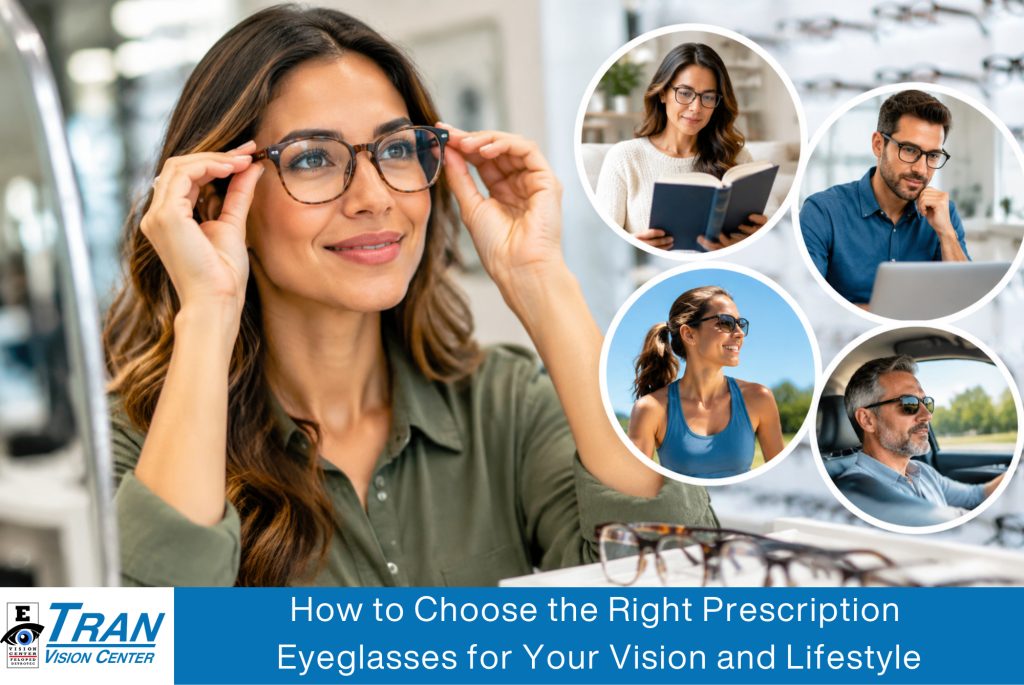
Prescription eyeglasses are more than a convenient way to improve blurry vision. Properly prescribed lenses support visual clarity, reduce unnecessary focusing effort, and help patients perform everyday activities comfortably.
Whether you spend hours working at a computer, frequently drive through Laredo, or need clearer vision for reading, selecting the right eyeglasses requires careful consideration of your prescription, lifestyle, and visual demands.
At Tran Vision Center in Laredo, TX, patients can explore prescription eyewear options designed to address their individual vision needs.
Understanding How Prescription Eyeglasses Correct Vision
Eyeglasses work by changing how light enters the eye, allowing images to focus more accurately on the retina.
According to the National Eye Institute, prescription eyeglasses are among the simplest and safest methods of correcting refractive errors.
Nearsightedness
Nearsightedness, or myopia, causes distant objects to appear blurry while nearby objects remain relatively clear.
Prescription lenses help redirect incoming light so distant objects become sharper.
Farsightedness
Farsightedness, or hyperopia, occurs when the eye does not focus incoming light correctly, potentially causing blurry near vision, visual fatigue, or difficulty concentrating on close tasks.
Astigmatism
Astigmatism results from irregular curvature of the cornea or lens. It can produce blurred or distorted vision at multiple distances.
Specially designed prescription lenses correct the associated focusing error.
Presbyopia
Presbyopia typically becomes noticeable after age 40 as the eye’s natural lens gradually loses flexibility.
People with presbyopia often experience difficulty reading small print or focusing on nearby objects.
Different Types of Prescription Eyeglass Lenses
Single-Vision Lenses
Single-vision lenses contain one prescription power throughout the lens.
They are commonly prescribed for distance vision, reading, or other specific visual tasks.
Bifocal Lenses
Bifocals contain two distinct prescription areas, generally providing correction for distance and near vision.
They are often useful for individuals who need different lens powers for reading and everyday activities.
Progressive Lenses
Progressive lenses provide a gradual transition between distance, intermediate, and near vision correction without visible dividing lines.
These lenses can be especially useful for patients who regularly alternate between driving, computer work, and reading.
Computer and Occupational Lenses
Occupational lenses are designed to provide comfortable vision at distances commonly used for computers, paperwork, and other workplace tasks.
They can be particularly beneficial for individuals experiencing visual discomfort during prolonged near work.
Lens Materials and Coatings: What Should You Consider?
High-Index Lenses
High-index lenses can provide thinner, lighter eyewear for patients with stronger prescriptions.
Polycarbonate and Trivex Lenses
These materials offer excellent impact resistance and are frequently considered for children, active adults, and individuals requiring protective eyewear.
Anti-Reflective Coatings
Anti-reflective coatings reduce reflections from lens surfaces, potentially improving visual clarity and comfort, especially during nighttime driving.
Photochromic Lenses
Photochromic lenses darken in response to ultraviolet exposure, providing convenient light adaptation.
Because many automotive windshields block ultraviolet light, certain photochromic lenses may not darken sufficiently inside vehicles.
UV-Protective Lenses
Ultraviolet protection is especially important in sunny climates such as South Texas.
The American Academy of Ophthalmology provides guidance on protecting the eyes from ultraviolet exposure and other environmental risks.
How to Choose Eyeglass Frames That Fit Properly
The right frames should provide a balance of comfort, durability, and appearance.
Important considerations include:
- Proper bridge fit
- Appropriate lens positioning
- Comfortable temple length
- Frame weight
- Compatibility with prescription lens thickness
- Stability during everyday movement
Poorly fitted frames can slide down the nose, cause pressure around the ears, or position prescription lenses incorrectly.
Professional measurements are especially important for multifocal and progressive lenses.
When Should You Replace Your Prescription Eyeglasses?
Eyeglasses should be reassessed when visual clarity changes or when frames and lenses no longer provide appropriate correction.
Signs that your prescription may need updating include:
- Increasing difficulty reading
- Blurry distance vision
- Frequent squinting
- Headaches during visual tasks
- Difficulty seeing road signs
- Problems adjusting between near and far distances
Scratched lenses, damaged coatings, and poorly fitting frames can also interfere with comfortable vision.
Why Professional Eyeglass Fitting Matters
A current prescription is only one component of effective vision correction.
Proper fitting ensures that lenses align with the eyes and that the frames remain comfortable during daily use.
Patients looking for prescription eyeglasses in Laredo, TX can consult Tran Vision Center about their visual requirements and available eyewear options.
Frequently Asked Questions About Prescription Eyeglasses
Do prescription glasses make your eyes weaker?
No. Prescription eyeglasses correct how light focuses on the retina. Wearing properly prescribed glasses does not weaken the eyes or accelerate refractive errors.
Are progressive lenses better than bifocals?
Neither option is universally better. Progressive lenses provide a continuous range of focusing powers, while bifocals offer two distinct prescription zones. The ideal choice depends on individual visual needs.
Can eyeglasses help reduce headaches?
Yes, when headaches are related to uncorrected refractive errors or certain visual demands. However, headaches can have many causes and may require additional medical evaluation.
Are expensive lenses always better?
Not necessarily. Lens suitability depends on prescription strength, material, coatings, optical design, and intended use.
Do I need separate glasses for computer work?
Some patients benefit from occupational lenses, particularly when standard distance or reading glasses do not provide comfortable intermediate vision.
How often should my eyeglass prescription be checked?
Your eye care provider will recommend an examination schedule based on your age, symptoms, and visual health. Schedule an earlier evaluation if you notice persistent changes in vision.
Contact Information
Tran Vision Center
5702 McPherson Rd #21
Laredo, TX 78041
Phone: (956) 791-5967
Website: tranvisioncenter.com
Eyeglasses: Explore Prescription Eyeglasses


